Have you noticed how mineral stains (water spots) embed deeper and deeper into your clear coat after each wash? Do you see micro rock chips on the front of your vehicle after a few months of driving on Laurentian roads? What you're observing isn't a minor cosmetic defect — it's the active depreciation of your asset.
A new luxury vehicle worth $80,000 to $150,000 loses an average of 15% to 20% of its value in the first year for market reasons. But add a hood riddled with 50 paint chips, a bumper yellowed by UV oxidation, and spiral micro-scratches from automatic car washes, and that depreciation climbs to 25-30%. On a $100,000 vehicle, that's a $5,000 to $10,000 differential in evaporated resale value — far exceeding the cost of comprehensive PPF protection.
The degradation is silent but inexorable. Every Quebec winter hurls thousands of micro-impacts of gravel and salt at your bodywork. Every incompetent wash etches circular micro-scratches (swirl marks) into the clear coat. Every bird dropping left uncleaned for 48 hours engraves a permanent acid imprint. These damages are cumulative and irreversible without costly professional paint correction.
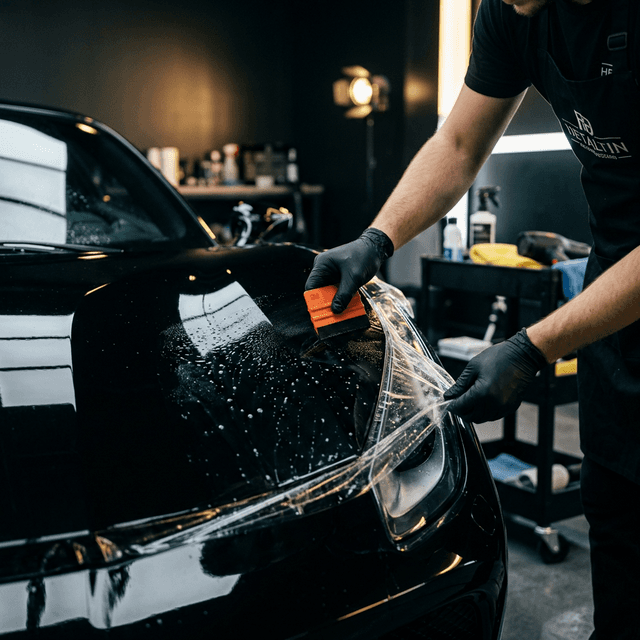
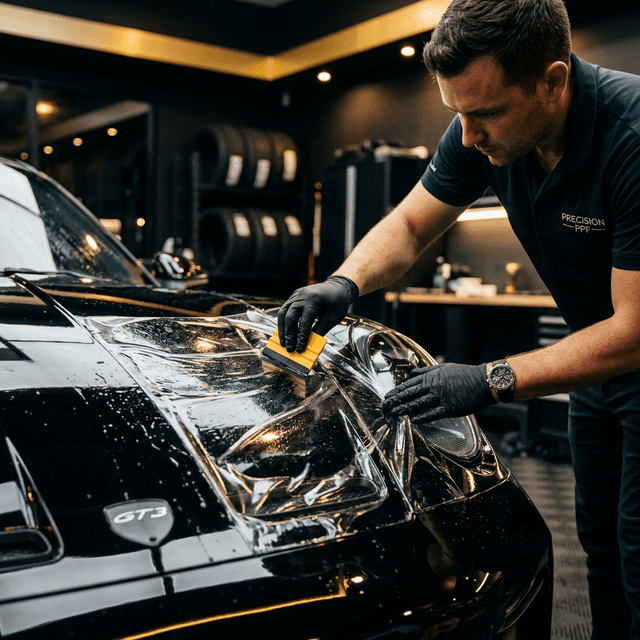
Let's do the reverse calculation. The cost of full front PPF protection (hood, bumpers, fenders, mirrors) typically runs between $1,200 and $1,800 for a standard vehicle, and $2,000 to $3,500 for a supercar. Divided by the 10-year warranty, that's $15 to $30 per month — less than your Netflix subscription — to fully preserve your vehicle's factory paint.
The question isn't: "Can I afford to protect my car?" The question should be: "Can I afford NOT to?" Every day of unprotected exposure is a day of accelerated depreciation. PPF isn't a luxury — it's an asset preservation strategy.
Our most savvy clients protect their vehicle straight from the dealership, before the first kilometer. Because a protection film can't repair existing damage — it can only prevent it. And in the world of automotive preservation, prevention is always infinitely less costly than repair.